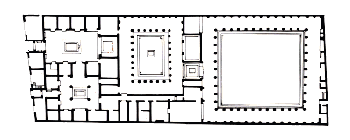
House of the Faun, Pompeii. Image: “HoFBuildingPlan”. Licensed under PD-US via Wikipedia
The Evolution of the Palazzo
As Roman houses developed through the medieval period, added elements of fortification, such as towers and gated doors, served a practical purpose in a city that was often besieged.

The medieval Torre Della Scimmia as painted by Ettore Roessler-Franz

Palazzo Altemps, with a decorative loggia in place of a defensive tower.

Interior courtyard of Palazzo Altemps
A Mix of Uses in the Renaissance Palazzo
The basic form of the renaissance palazzo has three parts. The base of the building, containing a large door and courtyard, was a place for business and for secure storage. Above this, an elevated and enlarged floor, called the piano nobile, held the important public spaces of the noble family. The floors above the piano nobile, the top of the building, could be subsidiary family space or room for tenants, and staff.

Interior courtyard of Palazzo Altemps, showing middle Piano Nobile zone.
A single palazzo building could therefore contain commercial, residential, and industrial spaces, all united by the patronage of the noble landlord. Rather than keeping different activities and uses in different buildings, the Palazzo keeps them all together, separated by floor, room, or hall.

Infinite Flexibility is Sustainable and Helps Build Community
As an urban building type, the palazzo form has the advantage of infinite flexibility. Because a palazzo is not designed for any one purpose, many different uses may come and go in the same building over the course of its history, provided the basic construction is of durable materials.
The diversity of residential space adds another kind of flexibility. Romans of different social and economic status live and work in the same building today, as they always have. A rich public life is possible because of this diversity. All classes of citizen are represented in the neighborhood markets, festivals, and daily routines.
The Magic of the Six Story Building
There is also an apparent limitation in the palazzo form which actually has had an advantageous effect on Roman urban life. Load bearing masonry construction limited the height of the renaissance palazzo to about six stories. This limitation to the number of upper residential floors provides neighborhoods with a population density high enough to support commerce, but low enough that a resident can know their neighbors. It supports the kind of relationships necessary for civic life. In short, it makes it possible to know one’s neighbors. This height limitation also means that an elevator is also not an absolute necessity, and a comfortable walk up a stair, like a comfortable walk down a street, is good for the citizen.


Diagram of an ideal Palazzo (left) and the variations possible due to site constraints (center and right)
 Quarter Mile Smile